TRAINING & EDUCATION
How to Choose a Good Personal Trainer: What Really Matters?
There is an enormous range of personal trainers, conditioning specialists and coaches working today. But how do you tell who really understands their profession? Is it their certificates, social media following, own physique or clients' achievements? In my view, the answer is a little more complex.

1. Client results are not automatically a measure of a coach's ability
One of the most common ways we judge coaches is by their clients' results. If a coach works with a successful professional athlete, we automatically assume a certain level of expertise.
Yet the reality may be different.
The athlete may have been achieving outstanding results long before the collaboration began. Their performance also depends on many factors: genetic predispositions, previous training, sports coaches, other members of the support team and the athlete's own discipline.
That certainly does not mean client results are unimportant. They matter. But a much more interesting question is:
How, specifically, did the coach contribute to achieving those results?
A good coach should be able to explain the starting point, why they chose a particular approach and how they evaluated its effectiveness.
2. Education matters. A certificate alone is not enough
I consider professional education an inseparable part of coaching.
Courses, seminars, specialist literature and discussions with other professionals can significantly broaden our knowledge and the way we think.
However, the number of courses a coach has completed does not tell us how well they can apply what they have learnt in practice.
What matters is not just what a coach knows, but above all how they use that knowledge.
Two coaches can complete the same course yet differ considerably in their ability to deal with specific training situations.
A good coach should understand not only what works, but also why, for whom and under what circumstances.
3. Decision-making matters, not just planning
Putting together a training programme is not particularly difficult today. There are plenty of accessible methods, programmes and tools to help.
But the real work of coaching begins when the plan no longer fits the situation in front of you.
What if a client arrives fatigued? What if their performance has stalled? What if a particular exercise consistently does not suit their movement capabilities?
That is when a coach's ability to assess the situation and make an appropriate decision becomes clear.
Sometimes the right response is to make training more demanding. At other times, it is to reduce the load, change the method or reconsider the original goal.
A good coach should therefore have a clear understanding of why they use a particular method, how they will assess its effectiveness and when it is appropriate to change course.
4. Communication and trust are part of professional competence
A coach may have excellent theoretical knowledge, but if they cannot communicate it clearly, its practical value is reduced.
Clients should understand why they are doing each exercise, what it is intended to achieve and what progress they can realistically expect.
A good coach can explain complex ideas simply, listen to feedback and create an environment in which clients feel comfortable asking questions.
Equally important is the ability to acknowledge uncertainty or the limits of one's expertise.
If a situation falls outside a coach's scope of practice, for example a suspected health problem requiring diagnosis or treatment, the appropriate response is to recommend working with a relevant healthcare professional.
That is not a sign of inadequate knowledge. Quite the opposite.
5. A good coach does not need to have every answer
Scientific knowledge in strength training, physiology and athletic preparation continues to develop.
Methods we considered optimal only a few years ago may now be viewed differently. There are also many questions to which we have no clear-cut answer.
That is why I consider intellectual humility one of the most important qualities of a good coach.
The ability to think critically, acknowledge a mistake, reconsider an opinion and take on new information.
A coach should not be an advocate for a single method. They should seek the most appropriate solution for the situation.
6. The personal dimension: when a coach and client simply click
One factor often overlooked when choosing a coach is personal compatibility. Everyone is different, and different people respond to different styles of communication, motivation and guidance.
Some people need an empathetic, patient and supportive approach. Others prefer a stricter, more direct style, sometimes almost like a drill sergeant. Neither approach is automatically better. What matters is whether it works for the individual.
And sometimes a coach and client simply do not click. That is absolutely fine.
I would compare it to going to a hairdresser. They may be convinced they have done a great job, used the right techniques and created the perfect haircut. Yet you leave unhappy because you are used to something different.
It does not necessarily mean they are a bad hairdresser. They simply may not be the right one for you.
I think coaching works in much the same way.
You may choose a coach who does not have the highest level of education, is unfamiliar with the latest training methods and is not doing everything optimally. Yet they may still be the best choice for you.
Simply because their personality suits you, they can motivate you, you look forward to training together and, as a result, you stay active over the long term. Provided, of course, that they work safely and respect the limits of their competence.
For professional athletes, specialist expertise, the ability to optimise performance and achieve specific results may carry more weight in certain situations. Even there, however, mutual trust and communication are important.
For recreational trainees, I would consider the personal dimension one of the most fundamental factors.
Not everyone goes to the gym with the ambition of achieving maximum results. For some people, training is a chance to unwind after work, switch off for a while, improve their mood or simply spend an enjoyable hour with someone they get along with.
And if that helps them exercise regularly, feel better and make movement a natural part of their life, it may be far more valuable than a few extra percentage points on the bar or slightly faster progress.
A good coach should therefore do more than plan training well. They should also recognise the person in front of them and adapt the way they coach that individual.
Because sometimes the best coach is not the one who produces the very best results on paper, but the one who helps you enjoy being active for the long term.
7. What would I look for when choosing a coach?
If I were choosing a coach today, these are the questions I would be most interested in:
How does your coach measure up?
0 / 8 selected
These questions are for reflection, not a scientifically validated assessment. Your choices are neither sent nor saved.
In conclusion
In my view, the quality of a coach is not defined by a single certificate, follower count, their own physical fitness or one athlete's success.
It is the result of a combination of professional knowledge, practical experience, decision-making, communication and the ability to work with an individual over time.
A good coach is not the person who knows the most exercises or promotes their methods the loudest. It is someone who can assess a situation accurately, choose an appropriate approach and explain the reasoning behind their decision.
At the same time, I believe that the best coach for one person may not be the best choice for another. Personal compatibility, trust and enjoyment of working together can be just as important as the training methodology itself.
Above all, a coach should be able to evaluate their own work critically and keep improving it.
Radek Rosa
Strength & Conditioning Coach
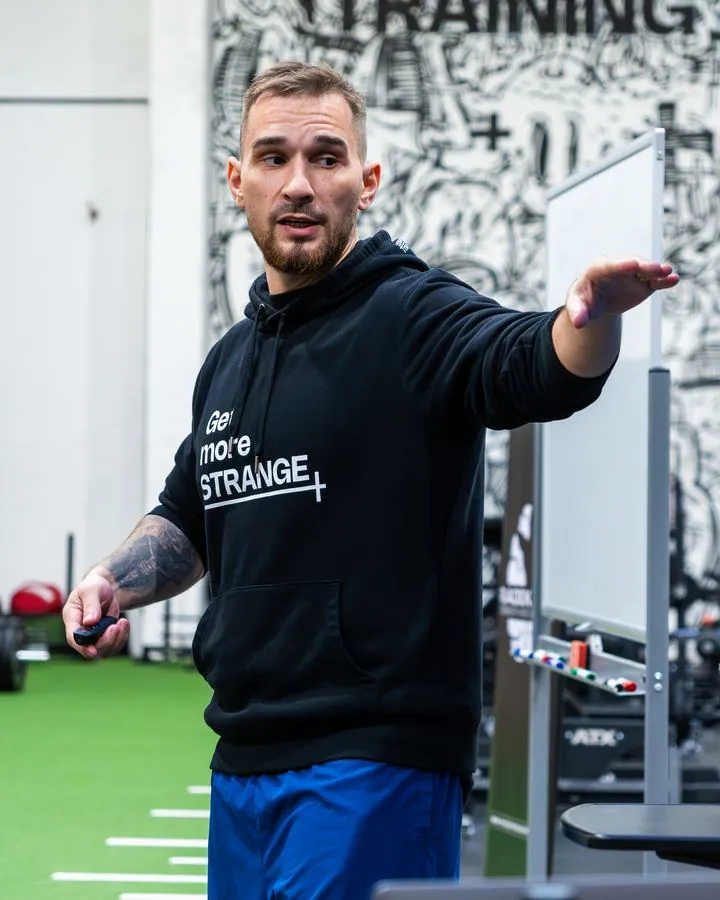
Radek Rosa
Strength and conditioning coach and educator. He works with athletes and the general population and provides education for coaches and physiotherapists.
More about Radek →Looking for a coach you will connect with?
Explore personal training or online coaching to see what working together could look like.